
During NGA’s Winter Meeting, a Democratic governor and Republican governor collaborated to highlight how the new federal tax credit scholarship program would expand educational options for students
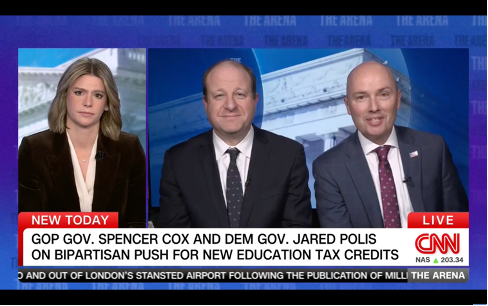
WASHINGTON, D.C. – Last week during the National Governors Association (NGA) Winter Meeting, Governor Jared Polis (D-Colorado) and Governor Spencer Cox (R-Utah) participated in an interview on CNN to discuss the new federal tax credit scholarship program, signed into law on July 4, 2025, and the opportunity it presents for states to expand educational options and services for families.
Click HERE to Watch
During the interview, Governor Cox highlighted his partnership with Governor Polis: “We’re very fortunate to get to work together as Governors…One of those bipartisan issues is education and education choice. We happen to be a red state and a blue state, a Republican and a Democrat, who both have opted in to this program to give up to $1,700 in tax credits to our families for things like tutoring, resources, for children with disabilities, and for tuition if families choose to go that direction.”
Their joint appearance underscored growing bipartisan recognition that the federal tax credit scholarship program provides governors with a unique opportunity to unlock additional resources for K–12 students without drawing on state budgets. By working across party lines, Governors Polis and Cox demonstrate that expanding educational opportunity can transcend traditional political divisions and focus squarely on empowering families.
The federal tax credit scholarship program will help students in K-12 education, in public and non-public schools, access a school or service of their parents’ choice. Scholarships are funded with private donations, not federal money, and donors receive a 100 percent federal tax credit of up to $1,700 annually. Students could use scholarships for tuition, academic tutoring, special needs services, education technology, fees for extended day programs, and other eligible uses.
Participation in the program is voluntary and requires governors to formally opt in for their states in order for their resident children to benefit. Governors must opt in by January 1, 2027, for students in their states to benefit when the program takes effect.
To date, 27 states have now officially opted in to the program, reflecting growing interest in expanding educational opportunities through private-sector investment to empower families with children in K-12 education.
Last week Peter Murphy, Vice President of Policy at IIEF, in a Washington Examiner article, described the advantages of governors opting in to the federal tax credit scholarship program. Peter highlighted that if a governor chooses not to opt into the program, students in that state would be unable to benefit from the scholarships, while taxpayers could still direct their donations to scholarship granting organizations in participating states. As a result, privately funded education dollars would flow out of the state to support students elsewhere. Ultimately, state leadership and governors opting in will determine whether families gain access to these new scholarship opportunities or see those resources flow out-of-state.
To learn more, please visit: scholarshiptaxcredit.org.
About Invest in Education Foundation
Invest in Education Foundation is a non-partisan research and policy 501(c)(3) organization that educates the public and policymakers about school choice as a means to expand educational freedom and opportunity for K-12 parents and students.
###